
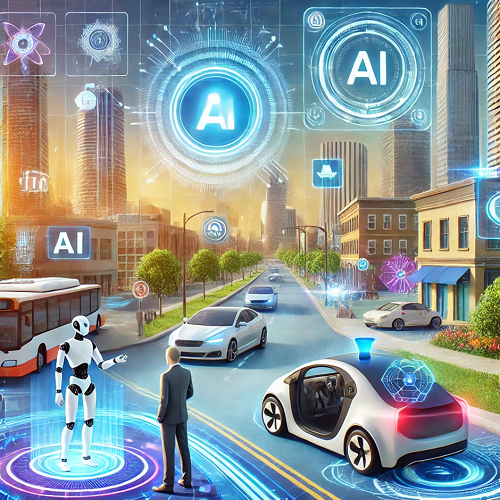
Artificial Intelligence (AI) is transforming industries, optimizing operations, and redefining human interaction with technology. From revolutionizing business and healthcare to enhancing everyday experiences, AI is driving efficiency and innovation at an unprecedented scale. With its ability to process vast data, automate tasks, and make intelligent decisions, AI is reshaping sectors like finance, education, and manufacturing.
As AI advances, ethical considerations and responsible development will play a crucial role in ensuring its positive impact. The future of AI is not just about automation but about augmenting human intelligence, fostering innovation, and shaping a smarter, more connected world.
AI Uses in Everyday Life
Artificial intelligence has already been integrated into our daily routines, and its future looks even more promising. Some exciting AI uses that will enhance everyday life include:
- Smart Assistants: Virtual assistants like Siri, Alexa, and Google Assistant will become even more intuitive and personalized.
- Automated Transportation: Self-driving cars and AI-powered traffic management systems will improve safety and efficiency.
- AI in Smart Homes: AI-enabled smart devices will automate household tasks, making homes more convenient and energy-efficient.
- Personalized Shopping: AI will continue to refine shopping experiences, offering personalized recommendations and faster deliveries.
With AI evolving constantly, our daily lives will become smarter, more efficient, and interconnected.
AI Uses in Business and Workforce Automation
Businesses are leveraging AI to streamline operations, optimize resources, and increase productivity. The future of AI uses in the workforce includes:
- Automated Customer Support: AI-powered chatbots and virtual assistants will enhance customer service experiences.
- Data Analysis and Insights: Businesses will use AI for predictive analytics, helping them make smarter decisions.
- AI in Hiring Processes: AI-powered HR tools will simplify recruitment, ensuring the best candidate matches.
- Workflow Automation: AI will take over repetitive tasks, allowing employees to focus on strategic projects.
By integrating AI, companies can reduce costs, boost efficiency, and improve decision-making.
AI Uses in Healthcare
The healthcare industry is witnessing a major transformation, thanks to AI-powered solutions. Some of the most impactful AI uses in healthcare include:
- Medical Diagnoses: AI algorithms will assist doctors in diagnosing diseases faster and more accurately.
- Robotic Surgeries: AI-powered robotic systems will enhance precision in complex surgical procedures.
- Drug Development: AI will help in discovering new medicines and improving treatment plans.
- Personalized Medicine: AI will tailor treatments to individual patients based on genetic and lifestyle factors.
With AI’s rapid advancements, the future of healthcare will be more efficient, accessible, and patient-centered.
AI Uses in Education
Education is evolving with AI-driven tools, making learning more interactive and accessible. Some AI uses that will shape the future of education include:
- Personalized Learning: AI-powered platforms will tailor lessons to students’ learning styles and paces.
- Virtual Tutors: AI chatbots and tutors will provide instant help for students struggling with concepts.
- Automated Grading: AI will streamline grading and assessment, giving teachers more time for instruction.
- Language Learning Assistance: AI-driven tools like Duolingo will improve language acquisition through adaptive learning.
These AI-driven innovations will make education more engaging and effective for students worldwide.
AI Uses in Entertainment and Media
The entertainment industry is experiencing an AI revolution, with cutting-edge technologies redefining creativity. Some futuristic AI uses in entertainment include:
- AI-Generated Content: AI will assist in creating music, movies, and art with minimal human intervention.
- Personalized Streaming: AI algorithms will improve content recommendations on platforms like Netflix and Spotify.
- Deepfake Technology: AI will revolutionize visual effects and film production.
- AI in Video Games: AI will create smarter, more adaptive gaming experiences.
With AI’s continuous advancements, entertainment will become more immersive, dynamic, and tailored to individual preferences.
AI Uses in Security and Cybersecurity
AI is crucial in enhancing security and protecting data from cyber threats. Some of the major AI uses in security include:
- Fraud Detection: AI will identify fraudulent transactions and prevent financial crimes.
- AI-Powered Surveillance: Intelligent cameras and security systems will detect threats in real time.
- Cybersecurity Defense: AI-driven security software will protect against malware and cyber-attacks.
- Facial Recognition: AI will improve identity verification in security-sensitive industries.
As cyber threats evolve, AI will play a crucial role in ensuring data security and preventing cybercrimes.
AI Uses in Climate Change and Sustainability
AI is contributing to environmental protection and sustainability efforts. Some significant AI uses in this domain include:
- Climate Prediction Models: AI will analyze climate data to predict and mitigate disasters.
- AI in Agriculture: AI-powered solutions will optimize farming techniques for better yield and sustainability.
- Smart Energy Grids: AI will improve energy efficiency and reduce carbon footprints.
- Waste Management: AI-driven robots will enhance recycling and waste reduction efforts.
AI-powered innovations will help tackle environmental challenges and create a more sustainable future.
AI Uses in Space Exploration
AI is playing a significant role in exploring the final frontier. Some futuristic AI uses in space exploration include:
- Autonomous Spacecraft: AI-driven navigation systems will enable self-sufficient space missions.
- AI in Astronomical Research: AI will analyze vast amounts of space data for discoveries.
- AI-Powered Rovers: Intelligent rovers will explore planetary surfaces with minimal human intervention.
- Predictive Maintenance: AI will help maintain space stations and spacecraft efficiently.
As AI continues to advance, space exploration will become more autonomous, efficient, and data-driven.
The Ethical Side of AI Uses
While AI has numerous benefits, ethical concerns must be addressed to ensure responsible development. Some key considerations for the future of AI uses include:
- Bias in AI Algorithms: Ensuring AI models are unbiased and fair.
- Privacy and Data Security: Protecting user data from misuse and breaches.
- AI and Job Displacement: Balancing automation with job creation.
- Regulatory Frameworks: Implementing AI regulations to ensure ethical development.
By addressing these concerns, AI can be developed responsibly for the benefit of society.
Conclusion
The future of AI uses is full of possibilities, revolutionizing industries, enhancing productivity, and improving everyday life. As AI continues to evolve, its impact will expand across various domains, making life more efficient, innovative, and exciting.
For now, there are AI Tools for Everyone To be utilized across various industries, offering a diverse range of services designed to streamline workflows. These intelligent systems provide advanced copywriting solutions, enabling businesses to generate compelling marketing copy, social media content, and blog articles with ease.
Beyond text-based tasks, AI-driven tools also specialize in graphic design, image creation, and video production, allowing users to create high-quality visuals without the need for extensive design expertise. Additionally, AI-powered platforms summarize complex documents, extract key insights, and generate well-structured text, making information processing faster and more efficient.
By leveraging these AI capabilities, businesses and individuals can automate repetitive tasks, optimize content creation, and improve overall efficiency, ultimately driving innovation and enhancing digital experiences.